- A resident falls in her room at 2 a.m. No one hears it. A night aide finds her forty minutes later while doing rounds. That forty-minute gap, not the fall itself, is often what turns a bruise into a hospitalization.
- This is the problem that AI Fall Detection for Senior Living technology solves. Not preventing every fall- no technology can do that- but closing the gap between when a fall happens and when someone responds. And in senior living care, that gap is measured in minutes that matter.
- For senior living operators comparing a fall detection device, fall alert devices, or a full fall detection solution for senior care, this guide covers how the technology works, what separates it from a basic pendant, and what to ask before you buy.
The Real Costs of Falls in Senior Living Communities
- Falls aren’t a minor operational inconvenience. According to the CDC Older Adult Falls Data, more than 1 in 4 adults aged 65 and older fall each year, and falls remain the leading cause of both injury and injury-related death in that age group.
- Every 11 seconds, an older adult is treated in a U.S. emergency room for a fall-related injury. Every 19 minutes, one dies from one.
- Inside a senior living community, the stakes compound. Residents are often on medications that affect balance, live with cognitive conditions that increase wandering risk, and may be physically unable to call for help after a fall.
- A resident who can’t reach an alert pendant, or who fell somewhere the pendant doesn’t reach, is invisible to a system that depends on them pressing a button.
- That’s the core failure of traditional emergency call systems: they require the resident to act. A fall sensor for elderly people that only works when the person presses it isn’t protecting the person who needs it most, the one who’s already down and can’t reach anything.
- This is also where many older medical alert systems with fall detection fall short in a community setting. They are built for one person at home, not for a building of residents, a night shift, and a staff team that needs a single, reliable view of every alert.
What Is Fall Detection and How Does Fall Detection Work?
What is fall detection? Fall detection is technology that automatically recognizes when a person has fallen and sends an alert so someone can respond, without the person having to press a button. For senior living communities, the goal is a fall detection system for elderly residents that reports to the care team, not just to a call center.
How does fall detection work? Most fall detection technology looks for two things: a sudden change in body position or movement, such as a rapid drop, followed by an absence of normal movement. Depending on the design, fall detection sensors fall into three broad groups:
- Wearable devices: Fall detection wearable devices, such as wristbands or pendants with built-in accelerometers, measure motion directly on the body.
- Ambient sensors: Radar, depth, or motion sensors mounted in the room detect falls without anything worn, which suits residents who forget or refuse to wear a device.
- AI-driven monitoring: Software analyzes sensor data to separate real falls from a dropped item or a resident sitting down quickly, which cuts false alarms.
Automatic fall detection devices of any type are only the first half of the system. What the platform does with the signal is what determines whether it protects residents.
What AI Fall Detection for Senior Living Actually Does?
- AI fall detection solutions for senior living care use passive sensors, wearables, or ambient monitoring devices to recognize the physical signature of a fall automatically, no button required. Depending on the system, this might combine motion sensors, wearable accelerometers, or radar-based ambient sensing that detects a body’s rapid downward movement and lack of subsequent motion.
- How does AI help prevent falls? In practice, it works on two timelines. In the moment, it detects the fall itself and triggers an alert instantly, cutting response time from “whenever someone happens to walk by” to seconds.
- Over time, it also builds a pattern: gait changes, slower movement, more nighttime bathroom trips, the kind of shifts that often precede a fall by days or weeks. Staff reviewing that data can flag a resident for a mobility assessment before the fall happens, not after.
- For many communities, AI adoption for senior living starts here, with passive monitoring that asks nothing of the resident and requires no change in behaviour to work.
- This is AI fall prevention in the sense that actually matters in senior care: not a promise that no one will ever fall, but a system that catches the early warning signs a busy staff member doing rounds every two hours simply can’t.
- Communities often describe these tools in different ways: fall alarms for seniors, fall monitors for seniors, a fall detector for elderly residents, or elderly fall alert devices. Whatever the label, what matters in a community is whether the system works automatically, covers the whole building, and reaches the right person.
Why Smart Alerts Are Important for AI Monitoring Senior Living Systems
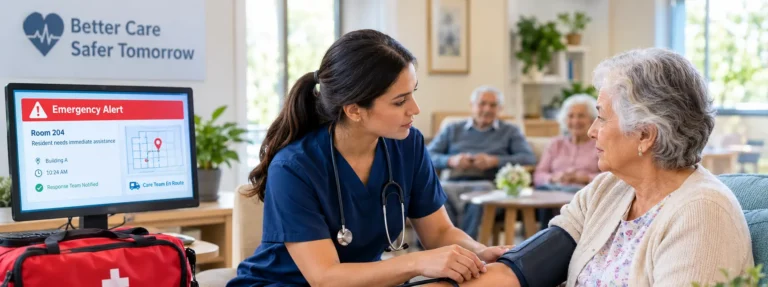
- A real-time fall detection system is only as useful as what happens after it fires. If an alert goes to a general call center and sits in a queue, you’ve replaced one delay with another.
- The better systems route differently depending on severity, and some fall detection devices call family directly for lower-urgency events, while routing anything serious straight to on-site staff and, when needed, emergency services.
- For operators, the useful version of fall alert devices for elderly residents is not a louder alarm. It is a smarter route: the right alert to the right person, with enough context to act.
- This matters operationally too. Alert fatigue is real: if every minor bump or false positive pages the same overworked night nurse, staff start treating every alert with less urgency, including the ones that count.
- A well-tuned fall detection sensor reduces noise instead of adding to it, which is the difference between a tool staff trust and one they learn to ignore. This is what separates genuine AI Monitoring senior living platforms from systems that simply collect data without acting on it intelligently.
Fall Detection System for Memory Care Communities
- Memory care is where passive monitoring matters most. Residents with dementia may not remember to wear a device, may not understand what an alert button is for, and may not be able to say they have fallen. A fall detection system for memory care therefore relies on ambient sensing and automatic alerts rather than anything the resident has to operate.
- Good memory care fall monitoring also respects dignity. Look for solutions that protect resident privacy, avoid intrusive cameras where possible, and give staff clear alerts without constant surveillance.
How AI Solutions for Elderly Care Fit into Daily Operations for Communities in the USA
- Fall detection in senior care facilities doesn’t function as a standalone gadget. It has to plug into the systems already running the building, nurse call infrastructure, staff communication tools, and resident records, or it becomes one more disconnected screen nobody checks consistently. This is where the technology conversation and the operations conversation have to happen together, not separately.
- Fall detection integration for senior living is where most deployments succeed or fail. A fall monitoring system for elderly residents should send alerts into your existing nurse call platform and staff devices, so caregivers respond from the workflow they already use. Exordium’s fall detection solutions for senior care are designed around that integration, which is why we treat it as part of the service rather than an add-on.
- At Exordium, our approach to AI Fall Detection solutions for Senior Living starts with how the alert reaches a human, not just how the sensor detects the fall. As an AI-managed service provider, we design AI solutions for senior care that do the constant, tireless watching, the kind no staff member could sustain across every room, every hour.
- The response, the decision about urgency, the call to a family member, the judgment about whether this resident needs a wellness check tomorrow, stays with trained people who know the resident and the building.
- That’s the honest version of this technology: it doesn’t replace the staff walking the halls. It gives them a way to be everywhere at once, without pretending a screen can make the human calls that actually matter after someone falls.
What to Ask Before Choosing an AI-Managed Service Provider in Texas, USA:
- If you’re evaluating fall detection for your community, skip the sales pitch and ask three things: How does the alert reach a person, and how fast? What happens when the system flags a false positive: does staff get buried in noise, or does it filter intelligently? And does it integrate with the nurse call and communication systems you already have, or does it sit next to them as one more thing to check?
- Two more questions are worth adding: Does the system work for every resident, including those who won’t wear fall detection devices for seniors? And will the provider support deployment, monitoring, and tuning across your community, not just hand over hardware?
- In the senior living industry, the successful AI adoption depends less on the sophistication of the sensor and more on the partner implementing it; the proper AI managed service provider will answer these questions before you are asked to sign anything.
- The technology exists to close the forty-minute gap. Whether it actually does depends entirely on how it’s implemented, not on the sensor alone.
- Looking for fall detection solutions for your senior living community anywhere in the USA? Talk to Exordium Networks about AI fall detection solutions built around your staff, your systems, and your residents.
About the Author
The Exordium Networks Editorial Team creates practical, research-backed content for senior living, healthcare, and business operations. With a focus on AI, automation, workforce solutions, and operational excellence, the team simplifies complex topics into actionable insights that help organizations improve efficiency while keeping people at the center of every decision.
Guided by Exordium’s philosophy of Human + AI, every article is written to support smarter business operations without losing the human touch.