Key takeaways
- Falls are an operator problem too: every one means a response, an incident report and possible claims.
- AI monitoring flags falls and early health changes so staff get targeted alerts instead of a wall of data.
- Before you buy, ask about false alarms, human validation, integration, network demands and overnight support.
- Monitoring only works when the network and nurse call system underneath it are reliable.
Over 14 million adults aged 65 and older report a fall every year, according to the CDC. About 37% of them are hurt badly enough to need treatment or cut back on activity, and the age-adjusted fall death rate rose 21% between 2018 and 2024. A night-shift caregiver cannot be in 60 rooms at once. AI monitoring for senior living can monitor every room, and that changes what a safe night looks like. For operators, each fall also means a response, an incident report and a possible claim, so speed and documentation matter.
How Is AI Being Used in Senior Living to Keep Residents Safe?
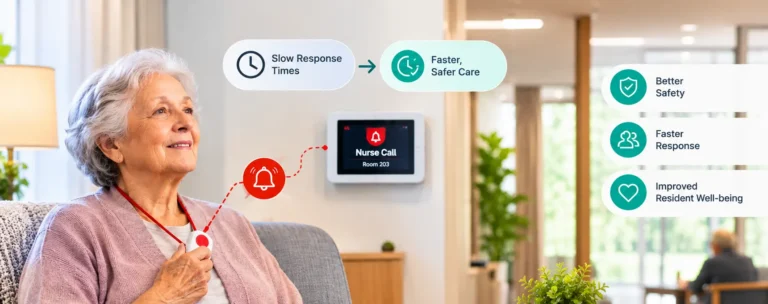
AI-powered resident monitoring pulls signals from sensors, cameras, wearables and nurse call systems, then flags what needs a human. The software learns each resident’s normal rhythm and alerts staff when something shifts: a fall, a resident wandering at 3 a.m., a bathroom trip that never ended or a missed meal. Staff receive a targeted alert instead of a wall of data, and the whole community stays covered while people tend to residents. That targeting matters for workload: with too many false alarms, caregivers start ignoring the system.
How Can AI Be Used in Elderly Care Beyond Falls?
Falls grab the headlines, yet trend data may deliver more value. Changes in sleep, gait speed and bathroom frequency can signal infections, dehydration or declining mobility days before a resident says a word. In the system described in a New York Times report republished by The Star, designated staff receive daily health information showing statistically significant changes, and one operator, The Bristal, reported that falls dropped 40% after detection went in. That is the value of trend data: it turns scattered observations into early warnings.
Automated Fall Detection in Senior Living: What the Numbers Say
- Automated fall detection in senior living pays off where speed matters.
- The CDC notes that falling once doubles the chance of falling again, so a fast response and a root-cause review protect a resident twice.
- Older adult falls also cost about $50 billion a year in medical bills.
- One vendor guide cites fall reductions of 40% to 74% in communities using AI, but those figures come from companies selling the tools, so ask for references from real communities.
- For operators, the stakes go beyond medical bills: claims, staffing strain and reputation all ride on how fast a fall is found and handled.
- Insurers are watching as well. WTW's 2026 guide for operators notes that resident fall claims rank among the highest in both severity and frequency.
- Alert logs and timestamps can also support incident documentation and inspection readiness by showing what happened and how quickly staff responded.
Four Types of AI-Based Monitoring Systems for Older Adults:
Here are the four main types and how they compare
| Type | Strength | Watch-out |
|---|---|---|
| Wearables | Work in common areas and outdoors | Residents forget or refuse to wear them |
| Camera-based (computer vision) | Detects falls and activity in real time | Privacy concerns and consent |
| Radar and ambient sensors | Camera-free, suits private spaces | Needs careful placement and calibration |
| Nurse call and IoT integration | Routes alerts to staff already on the floor | Depends on a stable network and compatible systems |
AI Monitoring Systems for Assisted Living: Questions to Ask Before You Buy
- How many false alarms should we expect per week? Alert fatigue kills adoption.
- Does a person validate alerts before staff respond?
- Which systems does it integrate with: nurse call, EHR, phones?
- What does it demand from our network, such as Wi-Fi coverage, power and cabling?
- How is resident data stored, and which HIPAA safeguards apply?
- How will we handle consent with residents and families?
- Who supports it at 2 a.m.?
Also ask how the vendor trains staff before launch, since adoption depends on caregivers trusting the alerts. Running several monitoring tools that do not integrate with nurse call or the EHR adds work rather than removing it.
Run a 60-day pilot in one wing, track falls, response time and false alarms, then expand what works.